Activity
Make an Orihon (Japanese Accordion Book)
Activity: In the following activity, you will make your own orihon to use as a journal. What stories might you record in it?
Activity
Activity: In the following activity, you will make your own orihon to use as a journal. What stories might you record in it?
Video
Explore Nara’s ancient Buddhist art and architecture.
Background Information
The year 2003 marked the 150th anniversary of diplomatic relations between the United States and Japan. Until 1853 Japan and the United States, located on opposite shores of the vast Pacific Ocean, had almost no contact. By choice, Japan had maintained itself as a nation with closed borders for more than two hundred years before this time, restricting foreign contact to relations with Dutch and Chinese traders, who were allowed access only to Nagasaki on the island of Kyushu. In contrast, the United States, faced with fierce international competition in the Pacific, aggressively sought new markets in East Asia. Thus, the establishment of relations with Japan became a popular topic for discussion in U.S. political circles.

Artwork
Scene from The Storehouse of Loyalty (Chushingura), 1806, by Hokusai (1760–1849). Japan. Edo period (1615–1868). Woodblock print, ink and colors on paper. Gift of Japanese Prints from the Collection of Emmeline Johnson, Donated by Oliver and Elizabeth Johnson, 1994.45.
Video
The “Paintings by Masami Teraoka” exhibition was on view at the Asian Art Museum from October 22, 1997 to January 25, 1998. This exhibition featured thirty-three current paintings and four prints by Masami Teraoka (b. 1936), a Japanese-born painter of contemporary American pop art. The Asian Art Museum was pleased to present Paintings by Masami Teraoka as a partial response to the frequently asked question, “What happened in Japanese art after the middle of the nineteenth century?”
Activity
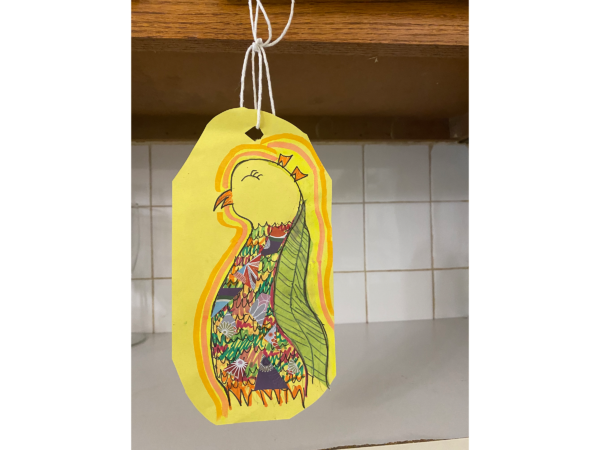
Learn about the Japanese supernatural creature Amabie and create an amulet with her image.
Video
An introduction to Shinto, one of Japan’s earliest belief systems.
Video
Learn more about the famous samurai story, the “Tale of the Heike” and hear Asian Art Museum Storyteller, Leta Bushyhead, tell an excerpt from the tale. This video include artworks from the Asian Art Museum’s collection.
Video
Japanese artist Tanabe Chikuunsai IV pushes the boundaries of bamboo art. He dramatically breaks the scale that we expect of the medium with soaring, twisting forms that stretch from floor to ceiling. His dramatic, immersive environments evoke the bamboo forests where these works began their lives.
Video
Ogawa Machiko’s artistic connection to raw natural beauty is linked to her time living abroad with her anthropologist husband as well as to the seaside landscape of her hometown of Sapporo on the island of Hokkaido. “It is my passion for the earth that drives my continual search for the essential in art. The vessel form, with both interior and exterior space, enables me to best pursue this quest — it is not about making vases. Rather, I am inspired by the concept of emptiness within the whole.”
* Ogawa studied ceramics with three Living National Treasures in Tokyo and at the Ecole des Arts et Metiers in Paris, then continued her studies in Burkina Faso in West Africa and in South America