Video
Great Power, Great Choices
Asian Art Museum Storyteller, Leta Busyhead, tells a story about Cyrus the Great and the Cyrus Cylinder in the Cyrus Cylinder and Ancient Persia exhibition at the Asian Art Museum (August 9–September 22, 2013).
Video
Asian Art Museum Storyteller, Leta Busyhead, tells a story about Cyrus the Great and the Cyrus Cylinder in the Cyrus Cylinder and Ancient Persia exhibition at the Asian Art Museum (August 9–September 22, 2013).
Video
GRAINS is an original audio-visual performance deals with expanding the sonic energy that resides in a single grain of sound. The performance explores the visual and sonic amplification of domestic food grains and their transformation into a collection of solid grains that flow like liquid as they multiply. Layering her vocals on top of the flowing grains, Surabhi Saraf weaves a rich tapestry of sounds, multiplied and fragmented, creating dynamic textures and immersive architectural soundscapes.
Artwork
Gourd-shaped incense container, 1625–1675. Attributed to Nonomura Ninsei (active 1625–1675). Japan; Kyoto. Kyoto ware, stoneware with underglaze iron-oxide decoration. Museum Purchase, B74P5.
Video
Farnoosh Fathi reads a poem she wrote in response to the artwork, “Untitled 1 (Peacock with Missiles),” 2010 by Adeela Suleman. This work is in the exhibition Phantoms of Asia: Contemporary Awakens the Past (on view at the Asian Art Museum from May 18–September 2, 2012). For more information: This presentation was part of MATCHA.
Artwork
This Goddess image appears in a niche on one side of the main structure of the great Shiva Nataraja (Dancing Shiva) a temple in Chidambaram, in the southern state of Tamil Nadu. Learn more.
Video
In Noh theatre (classical Japanese music drama), Japanese ghosts are usually upset females. Portrayed without feet because they have lost their connection to the earth, they are so filled with love, jealousy or rage that they won’t go peacefully into the night. Japanese believe ghosts are people who have died with an unpaid on — “debt” or “obligation.” If not repaid, the debt is passed down for generations, growing with each one like a snowball into an avalanche.
Video
Kabuki scholar Laurence Kominz discusses a woodblock print of a Kabuki actor and courtesan depicted in a scene from the famous Japanese epic The Tale of Genji.
Background Information
Background information on the Hindu deity, Ganesha, and Hindu architecture.
Video
The political enlightenment of the West articulated ideals that had no substantial counterpart in the spiritual traditions of Asia according to this event’s featured speaker, Akeel Bilgrami, a leading philosopher and political and cultural commentator. Yet Gandhi, appealing precisely to those traditions, managed to construct a radical political philosophy. In what ways was Gandhi modern despite his explicit opposition to modernity? Is Gandhi relevant to our own time and politics? Dr. Bilgrami presents Gandhi’s political philosophy to explore these questions and other contemporary concerns of religion, politics and culture.
Artwork
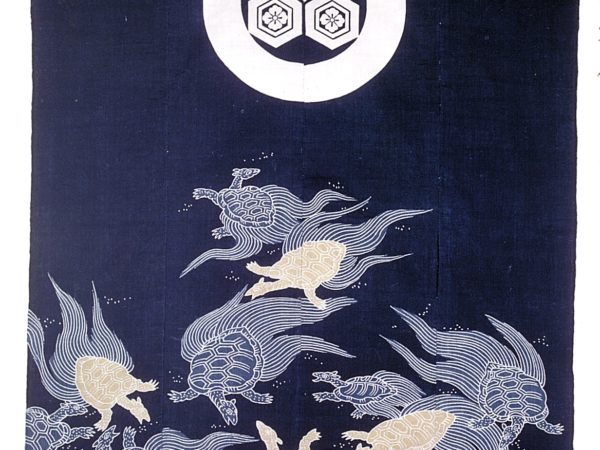
Futon cover with turtles and family crest, Meiji period (1868-1912). Japan. Indigo-dyed cotton with stencil-applied and hand drawn paste-resist (tsutsugaki) decoration. Gift of Mr. and Mrs. Samuel Newsom, B74M3.