Background Information
Japanese Painting: Nanga and Bunjinga School
During the Edo period, Nanga (southern painting) or Bunjinga (scholar or literati painting) artists took a form of Chinese painting as their model. Learn more.
Background Information
During the Edo period, Nanga (southern painting) or Bunjinga (scholar or literati painting) artists took a form of Chinese painting as their model. Learn more.
Background Information
The Kano school, established by Kano Masanobu (1434–1530), primarily served the samurai class. Their bold designs of powerful animals and symbolic plants and trees, blending aspects of native Japanese with Chinese styles, were the perfect decoration for screens and sliding doors in the large official audience halls in samurai residences. Learn more.
Background Information
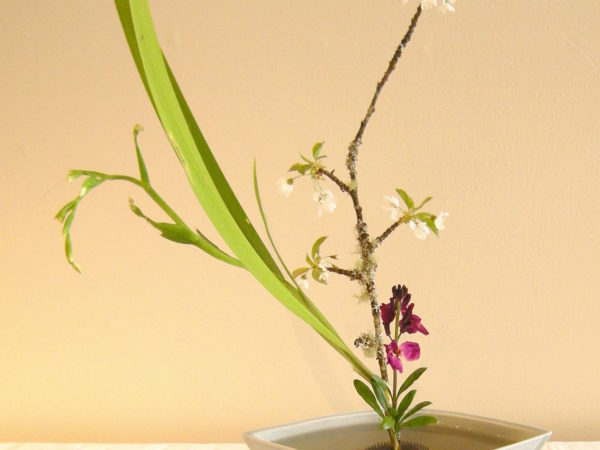
Learn about Japan’s refined form of floral arrangement, known as ikebana (“to arrange and give life to flowers”).
Artwork
Incense Container with design of plovers, 1500–1600. Japan. Muromachi period (1392–1573). Lacquered wood and sea shell. Gift by transfer from the Fine Arts Museums of San Francisco, B85M14.
Artwork
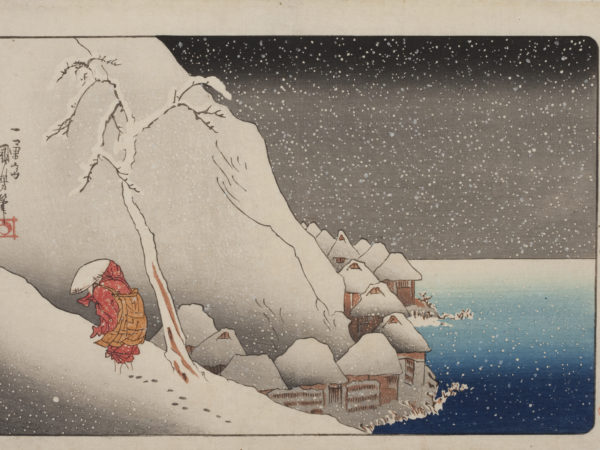
In the Snow at Tsukahara on Sado Island (Sashu Tsukahara setchu) from The Illustrated and Abridged Biography of the Founder [Nichiren] (Koso goichidai ryakuzu), by Utagawa Kuniyoshi (Japanese, 1797-1861). Japan. Woodblock print; ink and colors on paper. Gift of the Grabhorn Ukiyo-e Collection, 2005.100.118.
Video
Hailed as one of the most important photographers of our time, New York-based Japanese artist Hiroshi Sugimoto is also an accomplished architect. He approaches his work from many different perspectives, with architecture as one component in designing the settings for his installations. As a photographer of the highest technical ability, with equal acclaim for the conceptual and philosophical aspects of his work, Sugimoto has created works in his “Five Elements” series that are constructed as shrines to a primordial birthplace. Using geometric symbols from thirteenth-century Buddhism, Sugimoto encases a single image from his iconic Seascape series in each glass structure.
Background Information
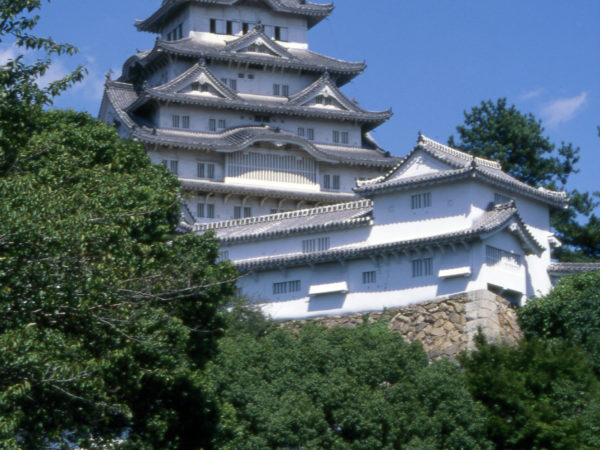
Himeji Castle is among the finest surviving examples of the defensive structures built in the sixteenth and early seventeenth centuries as samurai strongholds and symbols of power. Learn more.
Activity
Review the following steps to assist you in learning the art of meditation.
Video
Japanese artist and pop icon Fuyuko Matsui explores the haunted, interconnected realms of traditional and modern aesthetics. As one of the few women to have attained top training and mastery of traditional Japanese painting (nihonga) techniques in Japan, Matsui also cites centuries-old artistic influences, such as the iconoclastic eighteenth-century painter Soga Shohhaku and the fifteenth-century painter Soga Jasoku.
Artwork
Flowers and Birds of the Twelve Months, one of a pair (1703), by Yamamoto Soken (1683-1706). Japan. Six panel folding screen; Ink and colors on silk. The Avery Brundage Collection, B60D82+.1.