Activity
Unit: Life in China: Tang and Song Dynasties
Included are interdisciplinary suggested activities and downloadable handouts for approaching this subject through skill sets applied across world history studies.
Activity
Included are interdisciplinary suggested activities and downloadable handouts for approaching this subject through skill sets applied across world history studies.
Background Information
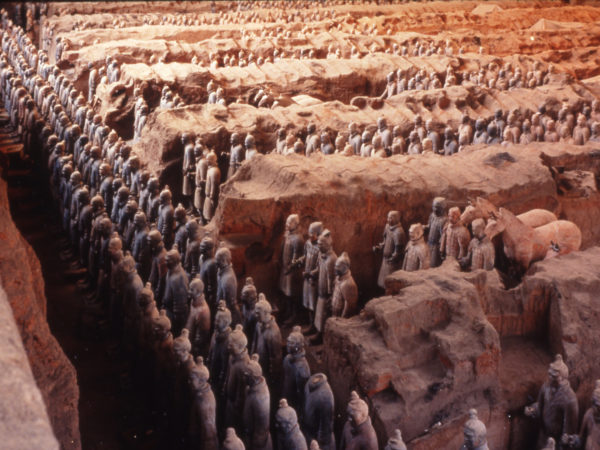
Just east of the modern city of Xi’an, you can see an army of soldiers unearthed. Discovered first in 1974, the work continues on three pits containing over 7,000 model soldiers. The army was buried within a framework of wooden pillars just east of the large tumulus containing the tomb of the First Emperor. It was a massive undertaking, certainly the largest ceramic project ever undertaken anywhere.
Background Information
Among the most globally significant innovations of the Tang and Song dynasties were the inventions of woodblock printing and moveable type, enabling widespread publishing of a variety of texts, and the dissemination of knowledge and literacy.
Activity
Students will become members of the “literati/scholar” class by demonstrating their understanding of Chinese history, philosophy, and poetry. They will also display high achievement in the “Three Perfections”: calligraphy, painting, and poetry. This project is designed to be a creative alternative to daily or weekly assignments which might otherwise be assembled in a notebook or binder at the end of the 7th-grade Medieval China unit.
Lesson
Students brainstorm the qualities of good and evil and draw conclusions about the Balinese concept of “dynamic” or balanced opposites. Then, students will relate the idea of “dynamic opposites” in the Ramayana (Story of Rama) to present-day situations by identifying a current problem, creating a visual identify for their own pair of opposing characters, and scripting a dialogue.
Video
Lesson
Students will: 1.) Learn that Buddhism is a religion founded by an enlightened young Indian prince who became the Buddha. 2.) Learn how the Buddha’s birthday, a national holiday, is celebrated in Korea. 3.) Discuss how the lotus flower is symbol of purity and wisdom. 3.) Construct a lotus blossom lantern.
Background Information
Scholars often refer to the Tang (618–907) and Song (960–1279) dynasties as the “medieval” period of China. The civilizations of the Tang (618–907) and Song (960–1279) dynasties of China were among the most advanced civilizations in the world at the time. Discoveries in the realms of science, art, philosophy, and technology—combined with a curiosity about the world around them—provided the men and women of this period with a worldview and level of sophistication that in many ways were unrivaled until much later times, even in China itself.
Video
Watch artist Kong Pak-yu demonstrate brushpainting at the Asian Art Museum.
Background Information
The Qin empire(221–206 BCE) of China lasted only fifteen years, but the rise of the state of Qin began several decades earlier, and Qin’s defeat of all the other rival states brought a definative conclusion to the Warring States period (475–221 BCE). Ying Zheng, the future First Emperor, ascended the throne of Qin in the year 247 BCE at age thirteen, and only a few years later launched a series of military campaigns against the neighboring states of Han, Zhou, Wei, Chu, Yan and Qi, defeating the last in 221 BCE, ‘as a silkworm devours a mulberry leaf ’ according to the Han historian Sima Qian.