Artwork
Gourd-Shaped Incense Container, 1625–1675
Gourd-shaped incense container, 1625–1675. Attributed to Nonomura Ninsei (active 1625–1675). Japan; Kyoto. Kyoto ware, stoneware with underglaze iron-oxide decoration. Museum Purchase, B74P5.
Artwork
Gourd-shaped incense container, 1625–1675. Attributed to Nonomura Ninsei (active 1625–1675). Japan; Kyoto. Kyoto ware, stoneware with underglaze iron-oxide decoration. Museum Purchase, B74P5.
Video
Farnoosh Fathi reads a poem she wrote in response to the artwork, “Untitled 1 (Peacock with Missiles),” 2010 by Adeela Suleman. This work is in the exhibition Phantoms of Asia: Contemporary Awakens the Past (on view at the Asian Art Museum from May 18–September 2, 2012). For more information: This presentation was part of MATCHA.
Artwork
This Goddess image appears in a niche on one side of the main structure of the great Shiva Nataraja (Dancing Shiva) a temple in Chidambaram, in the southern state of Tamil Nadu. Learn more.
Video
In Noh theatre (classical Japanese music drama), Japanese ghosts are usually upset females. Portrayed without feet because they have lost their connection to the earth, they are so filled with love, jealousy or rage that they won’t go peacefully into the night. Japanese believe ghosts are people who have died with an unpaid on — “debt” or “obligation.” If not repaid, the debt is passed down for generations, growing with each one like a snowball into an avalanche.
Video
Kabuki scholar Laurence Kominz discusses a woodblock print of a Kabuki actor and courtesan depicted in a scene from the famous Japanese epic The Tale of Genji.
Background Information
Background information on the Hindu deity, Ganesha, and Hindu architecture.
Artwork
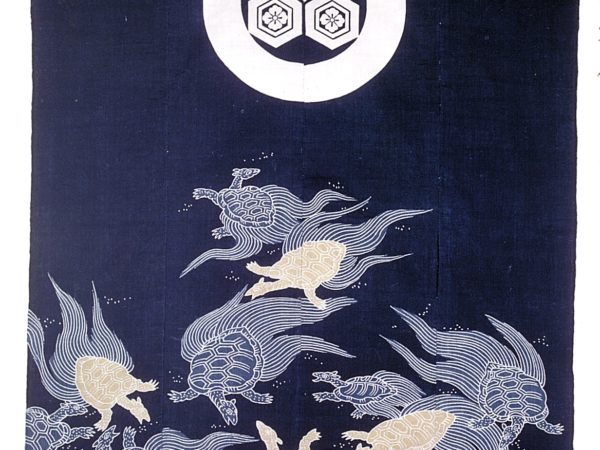
Futon cover with turtles and family crest, Meiji period (1868-1912). Japan. Indigo-dyed cotton with stencil-applied and hand drawn paste-resist (tsutsugaki) decoration. Gift of Mr. and Mrs. Samuel Newsom, B74M3.
Video
Fudo Myoo (the Immovable One) is one of the powerful deities known as the Five Bright Kings in Japanese Buddhism and folk religion. As a manifestation of the central cosmic Buddha Mahavairochana (Japanese: Dainichi), Fudo is believed to protect Buddhism and its true adherents. Like all Bright Kings, Fudo assumes a frightening form, with a sword in his right hand and a rope in his left. He sits in front of a swiring flame of fire, with which he purifies evil.
Artwork
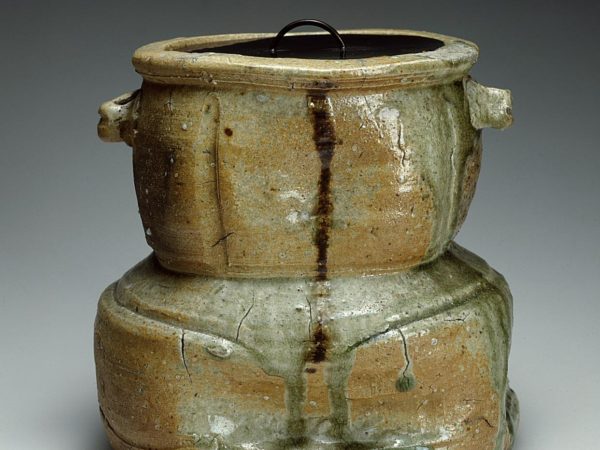
Fresh water jar, approx.1573–1615. Japan; Mie prefecture. Iga ware, stoneware with natural ash glaze. Museum Purchase, B68P4.
Artwork
Fresh water jar in the form of a wooden bucket, 1625–1635. Made in China for Japanese patrons. Porcelain with underglaze blue. Asian Art Museum, Gift of Roy Leventritt, B69P95L.